Trigger alert. Some people might be affected when hearing ‘aholic’ tags.
But you know what I mean. That first piece of chalk you ever used, where you drove the cue tip into the cavern of a worn-down square of blue chalk and called it good. No instructions. No technique. Just chalk up and shoot.
Well, my friends, chalk has come a long way from that blue square. And for a lot of players, the search for the perfect chalk never really ends.
The Blue Square
For most of us who grew up playing in bars and pool halls, chalk was just… chalk. Blue. Square. Sitting on the rail. You grabbed it, twisted it onto your tip a couple of times, set it back down, and that was that.
Nobody talked about it. Nobody had an opinion about it. It was just part of the ritual.
The brand didn’t matter, most of us didn’t even know there was a brand. All we knew was that it was blue, it was always there, and if you forgot to chalk up, you miscued. Simple as that.
Then Things Got Complicated
At some point, the pool world started paying closer attention to what was happening at the point of contact between cue tip and cue ball. Turns out, a lot was going on in that fraction of a second, and chalk played a bigger role than most people realized.
If you’ve never seen the slow-motion footage of a chalked cue tip striking a cue ball, Pooldawg has a video about Kamui Chalk that demonstrates what happens in that moment of contact. The way the chalk transfers, the way the tip compresses, and the dust storm left behind by some of the chalks in the video. Watch the video and then go compare your own chalk…You might be looking for a new one.
The result of all that attention? A lot more options on the market, and a whole community of players with very strong opinions about which chalk is best.
What’s Out There Now
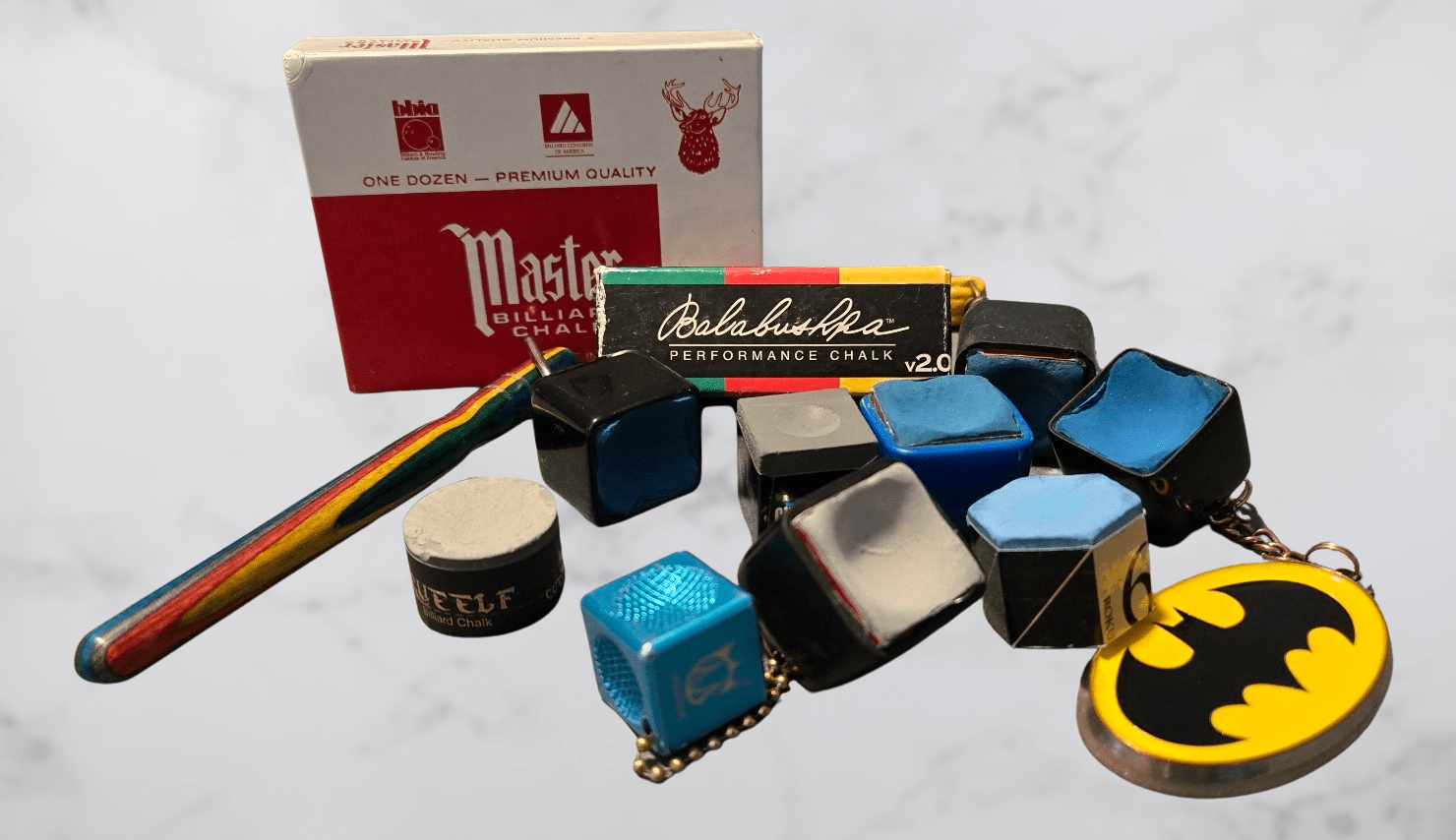
The modern chalk market ranges from the familiar to the surprisingly specialized.
Kamui chalk is one of the most talked-about in the serious amateur world. It’s designed to reduce miscues and extend the life of your tip, and it comes in different formulations depending on your tip type. Players who make the switch tend to stick with it.
Predator chalk is another widely used option, a step up from house chalk, consistent, and a good middle ground for players who want better performance without going deep into the chalk rabbit hole.
Taom is on the premium end. Finnish-made, designed to leave minimal residue on the cue ball, and popular among players who care about spin and cue ball control at a higher level. It’s the kind of chalk that makes you realize how the basic stuff was, in comparison. Not to mention that you just paid too much money on a single piece of chalk.
Application Matters Too
Beyond the chalk itself, how you apply it has changed. The old twist-and-grind method, driving the tip into the cube. That is one of the worst ways to chalk up. Not only does It dig a hole in the chalk, your cue ferule will get a blue ring from scraping the chalk sides.
The best approach is to scuff the cue tip with the corner of the chalk cube. apply across the tip surface, letting the chalk coat evenly without gouging. It feels different at first, but this gives you a chance between shots, and you can check to make sure your tip is covered with the right amount of chalk.
Some players tap the tip lightly before chalking to remove loose debris. Others blow on it. Everyone has a system, and most people are convinced theirs is correct.
One Chalk or Many?
Some players find a chalk they like and never look back. Others keep a rotation going. A different chalk for practice versus match play, or different chalk depending on the tip they’re using.
There’s no universally right answer. What works on a soft tip might not work the same way on a hard tip. What suits a player who relies on heavy spin might not be ideal for a more positional player.
The only way to know is to try a few and pay attention.
And if you find yourself with four or five different types of chalk in your cue case, comparing notes with other players at league night, well, welcome to the club.
Chalkaholic is not the worst thing to be.